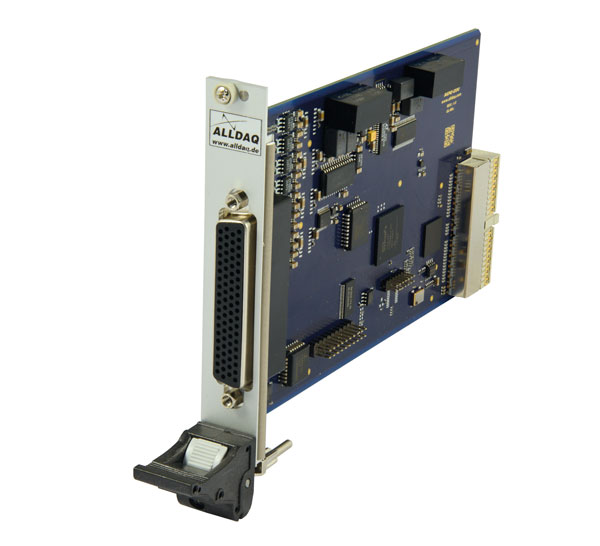
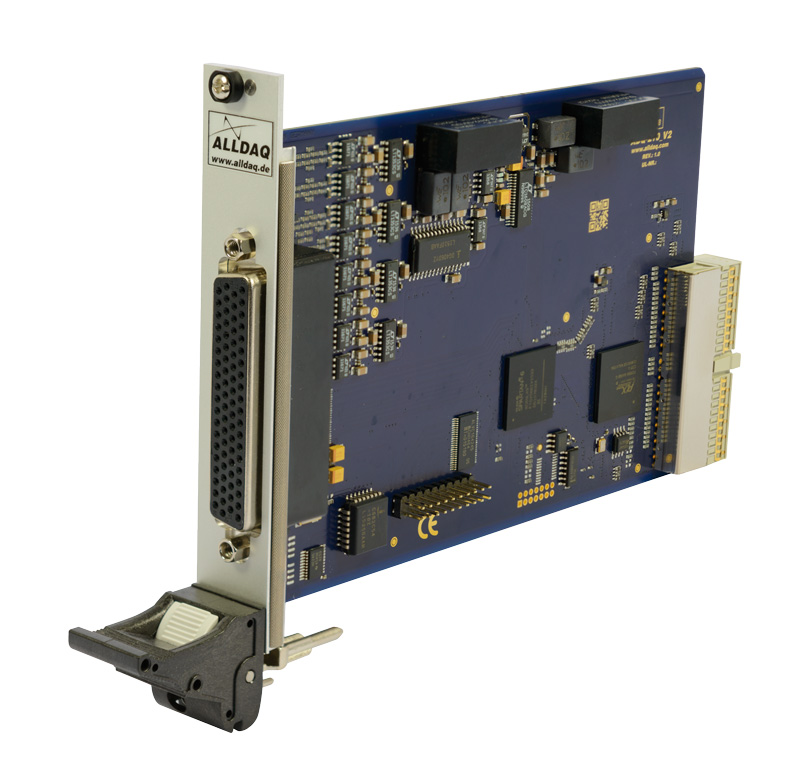
CompactPCI-Multi-I/O-Karte, 16 bit A/D-Teil bis 500 kHz mit 16 single-ended Analog-Eingängen (±10V), 32 bidirektionale TTL-Digital-I/Os (Pegel umschaltbar: 3,3V/5V), 1 Zähler (Typ: 8254) mit TTL-I/O-Pegel
Die Analog-Eingangskanäle der ADQ-210-Serie werden mit max. 500 kHz sequentiell gemäß Kanalliste abgetastet, d. h. bei Abtastung aller Kanäle beträgt die max. Abtastrate je Kanal: 500 kHz / 16 Kanäle = 31,25 kHz. Bandbreite und Eingangsimpedanz variieren je nach Modell. Die ADQ-211 ist eine robuste Allround-Multi-I/O-Karte, während das Einsatzgebiet von ADQ-212 und ADQ-215 im Bereich hochgenauer Spannungsmessung bis ±50 V liegt.
16 single-ended Analog-Eingänge
500 kHz 16 bit A/D-Wandler
Eingangsspannungsbereiche ±10V
Programmierbare Kanalliste: 16 Einträge
A/D-Werte-FIFO: 8192 Werte
Trigger: Software, Timer, ext. Digital-Trigger (steigende/fallende Flanke)
Zwei bidirektionale 8 bit Digital-I/O-Ports über Adapterkabel mit Zusatz-Slotblech nutzbar (inkl.)
Spannungspegel der Digital-I/Os per Software zwischen 3,3 V und 5 V umschaltbar (TTL-kompatibel)
3 x 16 bit Zähler (Typ: 8254), 6 Modi programmierbar
Externes Rechtecksignal für Zähler: max. 10 MHz
Umfangreiche Software-Unterstützung inklusive (siehe "Software"-Tab)
Benötigen Sie ein Kalibrierzertifikat?
Wir arbeiten mit unabhängigen DAkkS-akkreditierten Prüflabors zusammen.
Kontaktieren Sie unsere Experten!
CompactPCI Multi-I/O board, 16 bit A/D section up to 500 kHz with 16 differential analog inputs (±20V), 32 bidirectional TTL digital I/Os (level switchable: 3.3V/5V), 1 counter (type: 8254) with TTL I/O level
The analog input channels of the ADQ-210 series are sampled sequentially at max. 500 kHz according to the channel list, i.e. when all channels are sampled, the maximum sampling rate per channel is: 500 kHz / 16 channels = 31.25 kHz. Bandwidth and input impedance vary depending on the model. With an input voltage range of ±50 V, the ADQ-215 model is ideal for automotive applications.
16 differential analog inputs
500 kHz 16 bit A/D converter
Input voltage ranges ±20V
Programmable channel list: 16 entries
A/D values-FIFO: 8192 values
Trigger: software, timer, ext. digital trigger (rising / falling edge)
Two bidirectional 8 bit digital I/O ports usable via adapter cable with additional slot bracket (included)
Voltage level of the digital I/Os switchable between 3.3 V and 5 V via software (TTL compatible)
3 x 16 bit counter (type: 8254), 6 modes programmable
External square wave signal for counter: max. 10 MHz
Software support
Driver for Windows 10/8.1/8/7 (32/64 bit)
Programming support (SDK) with examples for C++, C#, Visual Basic, Delphi/Pascal and Python included
ALLDAQ Manager - utility software provides central access to ALLDAQ driver system parameters and help files
Virtual Instruments (VIs) for LabVIEW™
MATLAB® interface with examples and help file
Do you need a calibration certificate?
We work together with independent DAkkS-accredited test laboratories.
Talk to us!
Translated with www.DeepL.com/Translator (free version)
CompactPCI-Multi-I/O-Karte, 16 bit A/D-Teil bis 500 kHz mit 16 differentiellen Analog-Eingängen (±50V), 32 bidirektionale TTL-Digital-I/Os (Pegel umschaltbar: 3,3V/5V), 1 Zähler (Typ: 8254) mit TTL-I/O-Pegel
Die Analog-Eingangskanäle der ADQ-210-Serie werden mit max. 500 kHz sequentiell gemäß Kanalliste abgetastet, d. h. bei Abtastung aller Kanäle beträgt die max. Abtastrate je Kanal: 500 kHz / 16 Kanäle = 31,25 kHz. Bandbreite und Eingangsimpedanz variieren je nach Modell. Das Modell ADQ-215 ist mit einem Eingangsspannungsbereich von ±50 V ideal für Automotive-Anwendungen.
16 differentielle Analog-Eingänge
500 kHz 16 bit A/D-Wandler
Eingangsspannungsbereiche ±50V
Programmierbare Kanalliste: 16 Einträge
A/D-Werte-FIFO: 8192 Werte
Trigger: Software, Timer, ext. Digital-Trigger (steigende/fallende Flanke)
Zwei bidirektionale 8 bit Digital-I/O-Ports über Adapterkabel mit Zusatz-Slotblech nutzbar (inkl.)
Spannungspegel der Digital-I/Os per Software zwischen 3,3 V und 5 V umschaltbar (TTL-kompatibel)
3 x 16 bit Zähler (Typ: 8254), 6 Modi programmierbar
Externes Rechtecksignal für Zähler: max. 10 MHz
Software-Unterstützung
Treiber für Windows 10/8.1/8/7 (32/64 bit)
Programmier-Unterstützung (SDK) mit Beispielen für C++, C#, Visual Basic, Delphi/Pascal und Python inklusive
ALLDAQ-Manager - Utility-Software bietet zentralen Zugriff auf die Parameter des ALLDAQ-Treibersystems und auf Hilfe-Dateien
Virtual Instruments (VIs) für LabVIEW™
MATLAB®-Schnittstelle mit Beispielen und Hilfedatei
Benötigen Sie ein Kalibrierzertifikat?
Wir arbeiten mit
unabhängigen
DAkkS-akkreditierten
Prüflabors zusammen.
Sprechen Sie mit uns!
Isolierte Multifunktions-Datenerfassungskarte für universellen Einsatz in Industrie und Labor
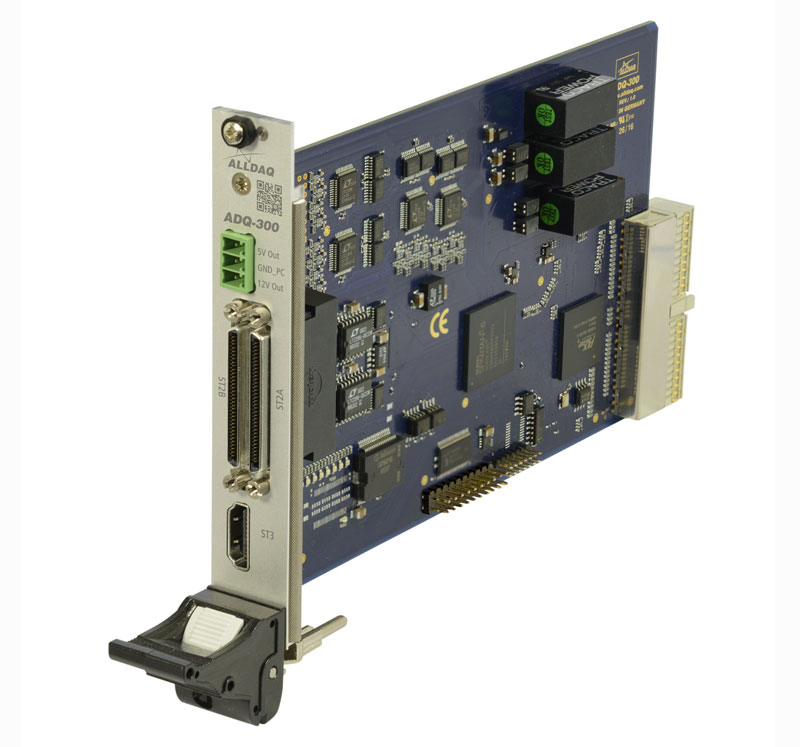
Die ALLDAQ ADQ-344 ist das Top-Modell der ADQ-300-Serie mit isoliertem A/D-, D/A- und Digital-I/O-Teil. Die ADQ-344 ist mit 32 differentiellen 18 bit Analogeingängen, vier 16 bit Analogausgängen, 8 isolierten Digital-Eingängen, 8 isolierten Digital-Ausgängen, 16 TTL-Digital-I/Os und Spezialfunktionen wie 32 bit Zähler, I2C-Bus, Inkrementalgeber, Frequenzmesser und PWM-Ausgabe ausgestattet.
Multifunktions-Datenerfassungskarte mit CompactPCI-Interface
32 isolierte, differentielle Spannungseingänge
Isolationsspannung A/D-Teil: 1500 VDC (60 s)
18 bit A/D-Wandler je Kanalgruppe mit Abtastraten zwischen 200 kS/s und 800 kS/s*
Eingangsbereiche: ±10,24 V, ±5,12 V, 0-10,24 V, 0-5,12 V
4 isolierte Spannungsausgänge (±10,24 V)
16 bit D/A-Wandler je Kanal für Ausgaberaten bis 500 MHz sychron
Isolationsspannung D/A-Teil: 1500 VDC (60 s)
8 isolierte Digital-Eingänge (High: 11..35 V)
8 isolierte Digital-Ausgänge mit Leistungstreiber bis 600 mA je Ausgang
16 TTL-DIOs (3,3 V oder 5 V umschaltbar), max. 20 mA je Ausgang
Isolationsspannung DIO-Teil: 500 VAC
Digitale Triggereingänge isoliert:
je 8 Analog-Eingänge (AI-Modul) ein ext. Triggereingang
je Analog-Ausgang ein ext. Triggereingang
Überwachung der Digitaleingänge auf Bit-Änderung mit Interruptgenerierung
Streamingbetrieb für kontinuierliche Ein-/Ausgabe via DIO-Ports bis 10 kHz**
Spezialfunktionen via HDMI-Steckverbinder (in Vorbereitung):
1 x 32 bit Zähler bis 66 MHz (Eingänge: Enable, ext. Trigger, ext. Takt, Ausgang: Strobe)
1 x I2C-Bus bis 400 kHz (Takt: SCL, Daten: SDA)
1 x Inkrementalgeber (A-Eingang, B-Eingang, ext. Reset-Eingang)
1 x Frequenzmesseingang bis 10 MHz (Zähl-Eingang)
1 x PWM-Ausgang, Tastverhältnis einstellbar (Enable-Eingang, PWM-Ausgang)
Optional geeignete Anschlusskabel (68-pol. VHDCI- bzw. HDMI-Kabel)
Optional Spezial-Anschlussblock für ADQ-300-Serie
Software-Unterstützung
Treiber für Windows 10/8.1/8/7 (32/64 bit)
Programmier-Unterstützung (SDK) mit Beispielen für C++, C#, Visual Basic, Delphi/Pascal und Python inklusive
ALLDAQ-Manager - Utility-Software bietet zentralen Zugriff auf die Parameter des ALLDAQ-Treibersystems und auf Hilfe-Dateien
Virtual Instruments (VIs) für LabVIEW™
MATLAB®-Schnittstelle mit Beispielen und Hilfedatei
Benötigen Sie ein Kalibrierzertifikat?
Wir arbeiten mit unabhängigen DAkkS-akkreditierten Prüflabors zusammen.
Sprechen Sie mit uns!
*Abtastrate abhängig von Anzahl aktiv genutzter Kanäle je Kanalgruppe (AI-Modul), eine Kanalgruppe besteht aus 8 Kanälen (1 Kanal: 800 kS/s, 2 Kanäle: 550 kS/s, 8 Kanäle: 200 kS/s)
**Abhängig von Betriebssystem und Rechnerkonfiguration.
Isolated PXI-Multi-I/O-DAQ-Board, 32 isolated differential voltage inputs, 18 bit A/D up to 800 kS/s, 4 isolated voltage outputs, 8 isolated digital inputs, 8 isolated digital outputs, 16 TTL-I/Os, GPIOs
€3,220.00*
This website uses cookies to ensure the best experience possible. More information...